“Higher thread count equals better sheets” is one of the most durable myths in bedding, and it sells a lot of mediocre products. The honest answer is that thread count matters far less than the packaging implies, and for bamboo sheets it’s nearly beside the point. Here’s what the number actually measures, why it became a fixation, and what you should look at instead.
What thread count actually measures
Thread count is simply the number of threads woven into one square inch of fabric, the horizontal threads (weft) plus the vertical ones (warp). A 300-thread-count sheet has roughly 300 threads packed into each square inch.
That’s the whole definition. Notice what it does not measure: the quality of the fiber, how long and fine the individual strands are, how the fabric is woven, or how it actually feels and breathes. It’s a density count, nothing more. Two sheets with identical thread counts can feel worlds apart depending on what they’re made of and how they’re woven. Treating one number as a quality grade was always a stretch.
Why it was a cotton metric
Thread count rose to prominence as a way to compare cotton sheets, and within cotton it had some logic. Finer cotton yarns let you weave more threads into the same space, so a higher count often did signal finer fiber and a smoother sheet, up to a point. Marketers seized on it because it’s a single, simple number that’s easy to print big on a package and easy for shoppers to “rank.”
But two things broke the metric. First, manufacturers learned to inflate it (more on that below), so the number stopped tracking quality even within cotton. Second, and more importantly here, the metric was never designed for other fibers. Bamboo lyocell isn’t cotton. Applying cotton’s yardstick to it, and assuming the same “more is better” rule holds, leads you straight to the wrong conclusion.
Why 300TC bamboo lyocell feels luxurious
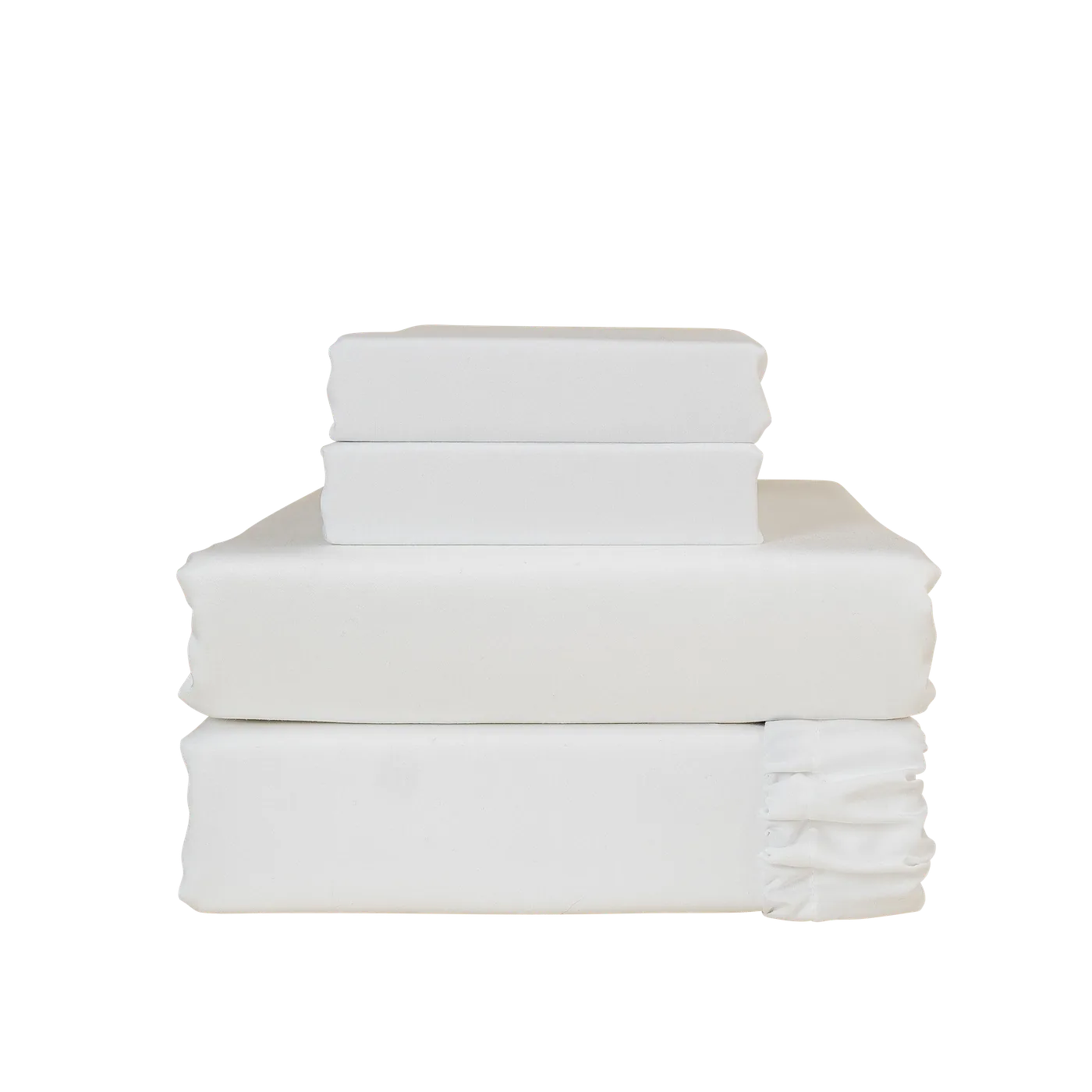
Here’s the part that surprises people: our bamboo sheet set is 300 thread count, and it feels as silky and luxurious as cotton sheets advertised at 800, 900, even 1000. That’s not spin; it’s a direct consequence of the fiber.
Bamboo lyocell fibers are naturally long, smooth, and fine. When you weave fibers like that, you get a soft, cool, almost silky hand at a moderate thread count, no cramming required. A cotton sheet has to pack far more threads of a comparatively coarser fiber to approach the same smoothness, which is why cotton’s “luxury” counts climb into the high hundreds and beyond. The bamboo fiber is doing the work that cotton tries to brute-force with sheer thread density.
So a 300-count bamboo sheet isn’t a “lower-end” sheet that happens to feel nice. It’s hitting the softness of a much higher-count cotton sheet while staying breathable, because it isn’t choking the weave with threads.
How fiber and weave beat raw thread count
If thread count isn’t the answer, what is? Two things: the fiber and the weave.
- Fiber quality is the foundation. Long, fine, smooth fibers, like bamboo lyocell or long-staple cotton, produce soft, strong, durable fabric. Short, coarse fibers feel rough and pill no matter how many of them you cram in.
- Weave shapes the final feel. A sateen weave (more surface threads exposed) feels silkier and has a subtle sheen; a percale weave feels crisp and cool. The weave determines drape, hand, and breathability as much as anything.
Put a great fiber and a thoughtful weave together and you get a sheet that feels luxurious at a sensible thread count. Use a poor fiber and a dense weave and no four-figure number will save it. Fiber plus weave beats raw count every time, which is the entire reason a moderate-count bamboo sheet can outperform a high-count cotton one.
The “1000 thread count” marketing trap
When you see budget sheets boasting 1000, 1200, or 1500 thread count, be skeptical, those numbers are almost always inflated. The most common trick is multi-ply counting. A single yarn is often spun from two or more thinner strands (plies) twisted together. Honest counting treats that twisted yarn as one thread. Inflated counting counts each ply: a genuine 250- to 300-thread fabric made from two-ply yarn gets advertised as 500 to 600, and three-ply pushes it higher still.
So a “1000 thread count” sheet may really be a 300- to 500-thread fabric dressed up with creative math, and frequently woven from cheaper, shorter fibers to keep the price down. You end up paying for a number, not a better sheet, and often getting something that breathes worse because of the dense weave. The big number is the red flag, not the badge of honor it pretends to be.
| Marketing claim | What’s often really going on |
|---|---|
| “1000 thread count!” | Multi-ply counting inflating a 300 to 500 real count |
| “Higher count = more luxurious” | True for cotton only up to a point; not for bamboo |
| “Hotel-quality 1500TC” | Dense weave that traps heat; often coarse fiber |
| “More threads = more durable” | Durability comes from fiber strength, not crowding |
Ideal thread-count range for bamboo (250 to 350)
For bamboo lyocell, the sweet spot is 250 to 350, with 300 sitting comfortably in the middle. Here’s why the band, not a single number, is what matters:
- Below ~250: the sheet can start to feel thin and less durable.
- 250 to 350: the ideal balance, silky-soft, strong, and still breathable. Bamboo’s fine fibers shine here without crowding the weave.
- Above ~350: diminishing returns set in. The weave gets denser, breathability drops, the price climbs, and you should start wondering whether the number is even counted honestly.
A higher bamboo thread count is not a better bamboo sheet, and it can be a worse one if it sacrifices the airflow that makes bamboo so cool to sleep on in the first place.
| Sheet | Thread count | Real-world feel |
|---|---|---|
| Bamboo lyocell (ours) | 300 | Silky, cool, breathable, rivals 800 to 1000TC cotton |
| Standard cotton | 200 to 400 | Decent, varies widely with fiber quality |
| “Luxury” cotton | 800 to 1000 | Soft but often dense and warm |
| “1000+” budget sheets | Inflated | Number is the selling point, not the fabric |
What to evaluate instead
If thread count is mostly noise, here’s the signal, what to actually check before you buy:
- Fiber and material. What is it really made of? Genuine bamboo lyocell, long-staple cotton, real mulberry silk? The fiber is the foundation of feel and durability.
- Weave. Sateen for silky and smooth, percale for crisp and cool. Match it to how you like sheets to feel.
- Certifications. OEKO-TEX Standard 100 means the fabric has been tested against harmful substances, real, verifiable, and far more meaningful than a thread-count claim. All our bamboo bedding is OEKO-TEX certified.
- Breathability and temperature. Especially for warm sleepers, airflow matters more than density. Bamboo’s natural breathability is a genuine advantage.
- Honest specs and reviews. Trust brands that explain why a sheet feels good rather than waving a giant number. See how the numbers really stack up on our comparison page.
Once you’ve found sheets you love, it’s worth coordinating the rest of the bed in the same fabric, our bamboo duvet cover carries the same cool, breathable feel across the whole bed, and you can browse the full range on our products page.
Key takeaways
- Thread count just counts threads per square inch, it says nothing about fiber quality, weave, or breathability.
- It was a cotton metric and doesn’t translate to bamboo; “more is better” simply doesn’t hold here.
- 300-thread-count bamboo lyocell rivals 800 to 1000TC cotton because long, smooth bamboo fibers do the work density tries to fake.
- Very high counts can hurt breathability by crowding the weave, and four-figure numbers are usually inflated by multi-ply counting.
- For bamboo, target the 250 to 350 range; 300 is ideal, and higher is not better.
- Evaluate fiber, weave, certification, and breathability instead, OEKO-TEX certification is far more trustworthy than any thread-count claim.