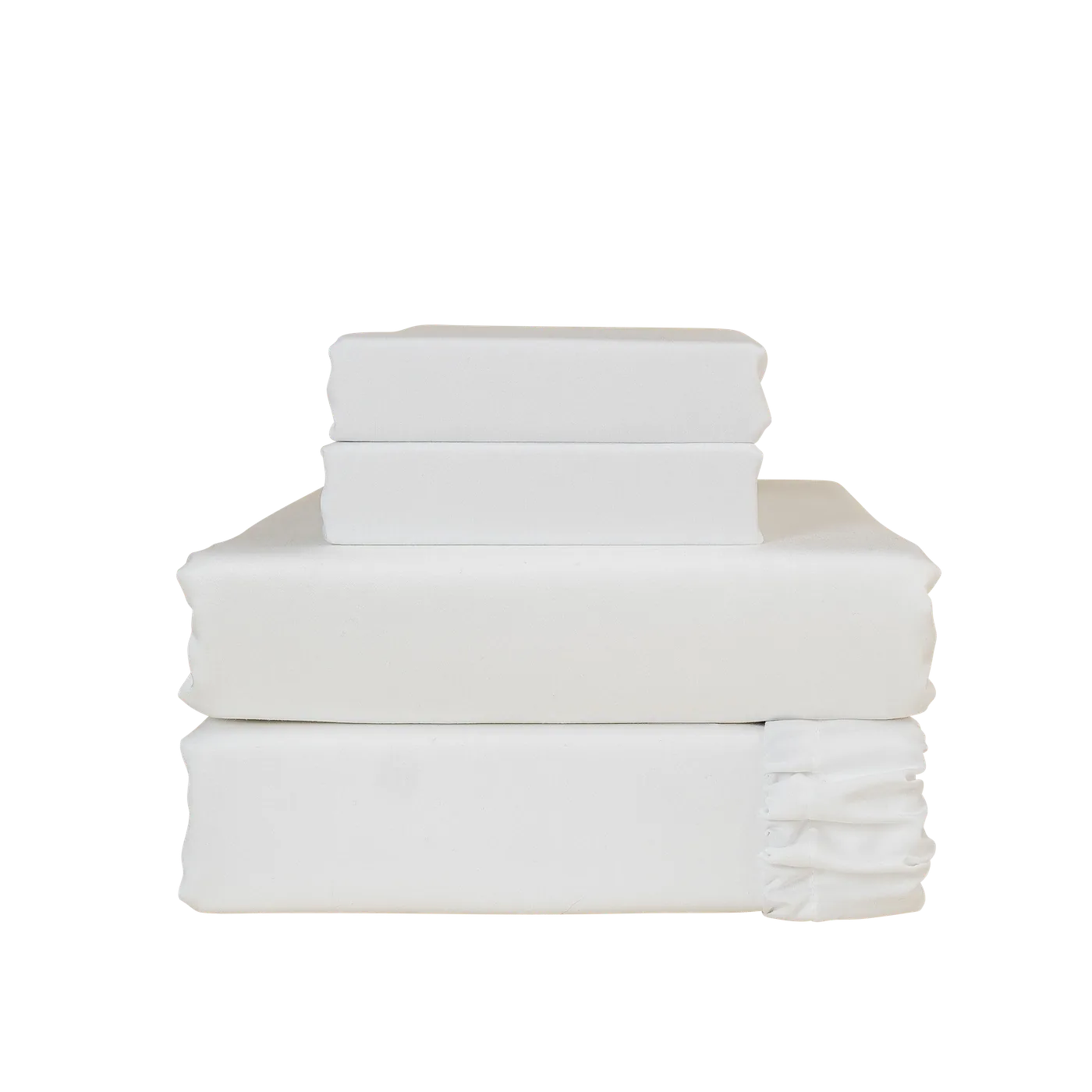
Pilling is one of the most misunderstood things about bedding. People see those little fabric balls form and assume the sheets were cheap, or that “real” bamboo wouldn’t do it. The truth is more useful: pilling is a mechanical process, and whether your sheets pill depends mostly on what they’re made of and how you wash them — not on some mysterious quality grade.
What pilling is and why it happens
A pill is a tiny tangle of broken fiber ends that work loose from the fabric surface, ball up, and stay attached by a few stubborn strands. It’s the same thing that happens to a cheap sweater. Three forces drive it:
- Short, loose fiber ends. Every fiber end on the surface is a potential pill. The more ends, the more pilling.
- Friction. Rubbing — body movement, rough mattresses, Velcro, the wash drum — abrades the surface and breaks fibers loose.
- Fiber strength. Weaker fibers snap into the short fragments that form pills more readily than strong ones.
The key insight: pilling is mechanical, not a sign of fake or low-grade fabric. A premium fiber abused with hot washes and a rough mattress can pill, while a modest one treated gently might not. So the question isn’t really “does bamboo pill” — it’s “what kind of bamboo, and how is it cared for.”
Why quality bamboo lyocell resists pilling
Good bamboo bedding is bamboo lyocell spun from long, continuous fibers. That length is the whole story.
When a yarn is made from long fibers, there are very few loose ends poking out of the surface — the fiber runs a long way through the yarn before it ever terminates. Fewer ends means fewer starting points for pills. The fibers are also spun into a smooth, even yarn, so the surface is slick rather than fuzzy, giving friction less to grab. A well-made bamboo sheet set leans on exactly this: long-fiber lyocell, single-fiber construction, smooth yarn. That’s why it resists the balling you might have seen on a discount “bamboo” set.
This is also why “100% bamboo” on the label is necessary but not sufficient — the fiber length and how it’s spun matter just as much as the percentage.
When bamboo blends pill (short-fiber joints)
Here’s where most bamboo-pilling complaints actually come from: blends.
When bamboo is mixed with cotton or polyester, the yarn now contains short staple fibers spliced together. Every splice is a fresh set of fiber ends. Short fibers also work loose far more easily than long ones because they’re held in place by less surrounding yarn. The result is a surface full of pill starting points — and worse, when polyester is in the blend, the pills don’t even fall off the way natural-fiber pills do, because the synthetic strands holding them are strong. So they cling and accumulate.
If you’ve owned “bamboo” sheets that pilled badly in the first month, there’s a strong chance they were a short-fiber blend, not 100% long-fiber lyocell. The plant was never the problem; the construction was.
Wash mistakes that cause pilling
Even great sheets pill if you launder them like a rag. The common offenders:
| Mistake | Why it causes pilling | Do this instead |
|---|---|---|
| Hot water | Weakens and swells fibers, increasing breakage | Cool or warm wash |
| Too much detergent | Residue stiffens fibers and adds abrasion | Small amount of mild detergent |
| Fabric softener | Coats fibers and masks/encourages surface wear | Skip it entirely |
| Overloaded machine | More crowding means more friction | Wash with room to move |
| Washing with rough items | Towels, zippers, Velcro abrade the surface | Wash sheets separately |
| High-heat drying | Heat plus tumbling = maximum friction | Low heat or line dry |
The pattern is simple: anything that adds heat, residue, or friction shortens the life of the smooth surface. Our full routine lives in how to wash bamboo sheets, but those six fixes prevent the large majority of pilling.
How to remove existing pills safely
If your current sheets have already pilled, you can usually restore them — carefully.
- Use the right tool. A battery or electric fabric shaver is ideal. A fine-tooth sweater comb works on lighter pilling.
- Lay the sheet flat on a hard, smooth surface so you’re not catching folds.
- Work in one direction with light, even pressure. Let the tool do the cutting; don’t press hard.
- Never use scissors or a razor blade. One slip nicks the weave, and that nick becomes a new weak spot — and a new pilling source.
- Wash gently afterward (cool water, mild detergent, low heat) so you don’t immediately re-roughen the surface.
De-pilling is maintenance, not repair — it removes the symptom. To stop pills coming back, fix the underlying cause: reduce friction in the bed and correct the wash routine.
How Delite’s bamboo resists pilling
We build around the things that actually prevent pilling rather than marketing around it:
- 100% long-fiber bamboo lyocell, not a short-staple blend, so there are few loose ends to ball up.
- Single-fiber construction — no cotton or polyester spliced in to introduce short fibers.
- OEKO-TEX Standard 100 certified, meaning the finished fabric has been tested free of many harmful substances. (To be candid: that’s a safety certification, not a durability one — but a brand willing to certify the finished textile is usually paying attention to construction too.)
- A 300-thread-count weave that’s smooth and consistent, balancing softness with a stable surface.
We pair the same fiber logic across the line, so a matching bamboo duvet cover behaves the same way the sheets do. And because pilling resistance is a long-game property, the 30-night trial lets you confirm the hand-feel holds up through real washes.
Buying checklist to avoid pilling
Before you buy any “bamboo” sheets, run this list:
- Is it 100% bamboo lyocell, single fiber? Avoid bamboo-cotton or bamboo-poly blends if pilling is your concern — the splices are the problem.
- Does it say long-fiber or lyocell, not just “bamboo viscose rayon”? Construction language matters.
- Is there an OEKO-TEX Standard 100 certification? It signals a brand testing the finished textile.
- Is there a real trial period? Pilling shows up over washes, so you want time to judge it — not a 7-day window.
- Does the care guidance say no fabric softener and low-heat drying? A brand that knows its product will tell you this up front.
Compare constructions side by side on our comparison page or browse the full range on the products page.
Key takeaways
- Pilling is mechanical — caused by short fiber ends, friction, and harsh washing — not evidence that bamboo is fake or low quality.
- Genuine 100% long-fiber bamboo lyocell resists pilling because long, smoothly spun fibers leave few loose ends to ball up.
- Most “bamboo pilling” complaints trace back to short-fiber blends; the splices and short staples are the real culprits, not the plant.
- Hot water, excess detergent, fabric softener, overloading, and high-heat drying are the wash mistakes that create pilling — fix those first.
- Remove existing pills with a fabric shaver or sweater comb, never scissors or a razor, then wash gently so they don’t return.
- When buying, insist on single-fiber long-staple lyocell, an OEKO-TEX certification, and a real trial period long enough to judge durability across washes.