Cotton has been the default bedsheet for generations, but bamboo lyocell has earned a real following among people who sleep hot, wake up sweaty, or simply want a softer, cooler surface. Both are good fibers — the right answer depends on how you sleep and what you value.
What are bamboo lyocell and cotton, exactly?
Cotton is a natural plant fiber spun directly from the cotton boll. Its quality hinges on staple length: long-staple varieties (like Egyptian or pima) produce stronger, smoother yarns than short-staple commodity cotton.
Bamboo lyocell is a regenerated cellulose fiber. Bamboo pulp is dissolved and extruded into filament in a closed-loop process, producing an exceptionally smooth, round fiber. That smoothness is why bamboo lyocell feels fluid and cool against skin, and why it resists the rough, fuzzy hand that lower-grade cotton can develop. It’s worth being precise here: “bamboo” sheets are technically a bamboo-derived lyocell, not raw bamboo grass woven into fabric.
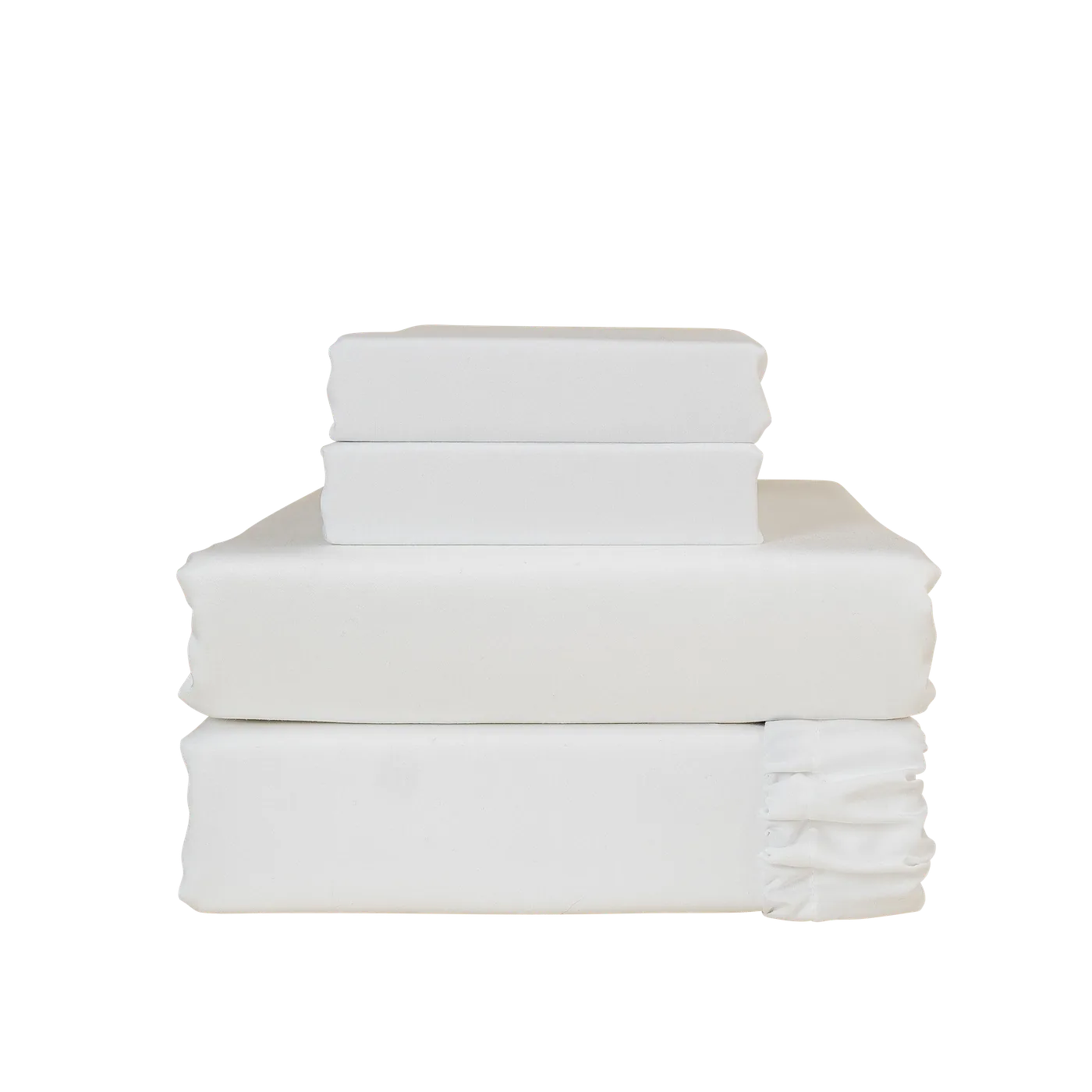
Our bamboo sheet set uses a 300-thread-count bamboo lyocell that’s certified to OEKO-TEX Standard 100, meaning the finished textile was tested free of many harmful substances. That’s a safety certification — it’s about what’s not in the fabric — and it applies equally to quality cotton sheets that carry it.
Cooling and breathability: which sleeps cooler?
This is where bamboo lyocell tends to pull ahead. The fiber’s smooth structure and high moisture affinity let it move heat and humidity away from your body quickly, so the surface feels cool rather than clammy.
Cotton breathes well too, especially in a light percale weave. But heavier cotton sateens can trap heat, and once cotton absorbs sweat it holds onto it longer, which is what creates that damp, sticky feeling at 3 a.m.
| Factor | Bamboo lyocell | Cotton |
|---|---|---|
| Surface feel | Cool, fluid, silky | Cool (percale) to warm (heavy sateen) |
| Heat dissipation | Excellent | Good |
| Feels damp when sweating | Rarely | More often |
| Best weave for cooling | Sateen ~300TC | Lightweight percale |
Moisture-wicking: bamboo’s biggest edge
Moisture regain is the share of moisture a fiber can hold relative to its dry weight, and it’s a useful proxy for how a sheet handles sweat. Bamboo lyocell sits around 12–13% moisture regain, while cotton lands closer to 6–9%. In plain terms, bamboo can absorb and release more humidity before it feels wet — so it keeps the sleep surface drier through the night.
For hot sleepers, night-sweat sufferers, and anyone navigating hot flashes, this is the single most important difference. If that’s you, it’s worth reading our deeper dive in the journal on night sweats and hot flashes.
Softness and feel: a matter of preference
Softness is subjective, but the type of softness differs:
- Bamboo lyocell is slinky and smooth from the very first night — closer to a silk or high-end sateen. It drapes over the body rather than sitting on top of it.
- Cotton ranges widely. Percale is crisp and matte with a hotel-bed snap; cotton sateen is smoother but heavier. Long-staple cotton softens beautifully over many washes, though it rarely matches bamboo’s initial slip.
If you love that first-night “ahh” of a smooth, cool sheet, bamboo delivers it immediately. If you prefer a crisp, structured bed that breaks in over time, percale cotton is hard to beat.
Durability and lifespan: how long will they last?
Honestly, both fibers can serve you for years — and care matters more than the label. Long-staple cotton has a slight edge in raw abrasion resistance, which is why it’s a workhorse for high-traffic guest rooms and kids’ beds.
Bamboo lyocell resists pilling and holds its softness well, but it’s less forgiving of abuse: chlorine bleach weakens the fiber, fabric softener coats it and dulls the cool hand, and high dryer heat accelerates wear. Treat bamboo gently and it rewards you. (Our full care routine walks through exactly how.)
| Durability factor | Bamboo lyocell | Cotton |
|---|---|---|
| Pilling resistance | High | Moderate (varies by staple) |
| Abrasion resistance | Good | High (long-staple) |
| Bleach tolerance | Low — never bleach | Moderate |
| Sensitivity to high heat | High | Moderate |
Price and value: what you actually pay for
Commodity cotton is the cheapest bedding on the market, and you can find serviceable cotton sets for very little. But premium long-staple cotton and quality bamboo lyocell sit in a similar mid-to-upper price band.
The value question is what you’re optimizing for. If you sleep hot and want lasting comfort, bamboo’s cooling and moisture performance often justifies its price. If you want maximum durability per dollar for a hard-working bed, quality cotton stretches further. We bundle the bamboo sheet set with a matching duvet cover and other pieces — see the full bundles and a side-by-side on the comparison page to weigh the trade-offs.
So which should you buy?
Match the fiber to your sleep:
- Choose bamboo lyocell if you sleep hot, wake up sweaty, want silky-smooth softness from night one, or have sensitive skin that likes a dry, smooth surface.
- Choose cotton if you love a crisp percale feel, prioritize maximum abrasion resistance for a heavily used bed, or want the lowest entry price.
For most people deciding between the two on comfort grounds, bamboo lyocell is the more forgiving choice for temperature and moisture — the two things that most often wreck a night’s sleep.
Key takeaways
- Bamboo lyocell wicks more moisture (~12–13% regain) than cotton (~6–9%), so it usually sleeps cooler and drier.
- Bamboo feels silky and cool from the first night; cotton ranges from crisp percale to heavier sateen.
- Long-staple cotton is slightly more abrasion-resistant; bamboo resists pilling but dislikes bleach, softener, and high heat.
- OEKO-TEX Standard 100 is a safety certification (tested free of many harmful substances), not by itself a sustainability claim.
- Weave matters as much as fiber — a 300TC bamboo sateen rivals far higher cotton thread counts.
- Hot sleepers usually prefer bamboo; budget-durability shoppers may prefer quality cotton.