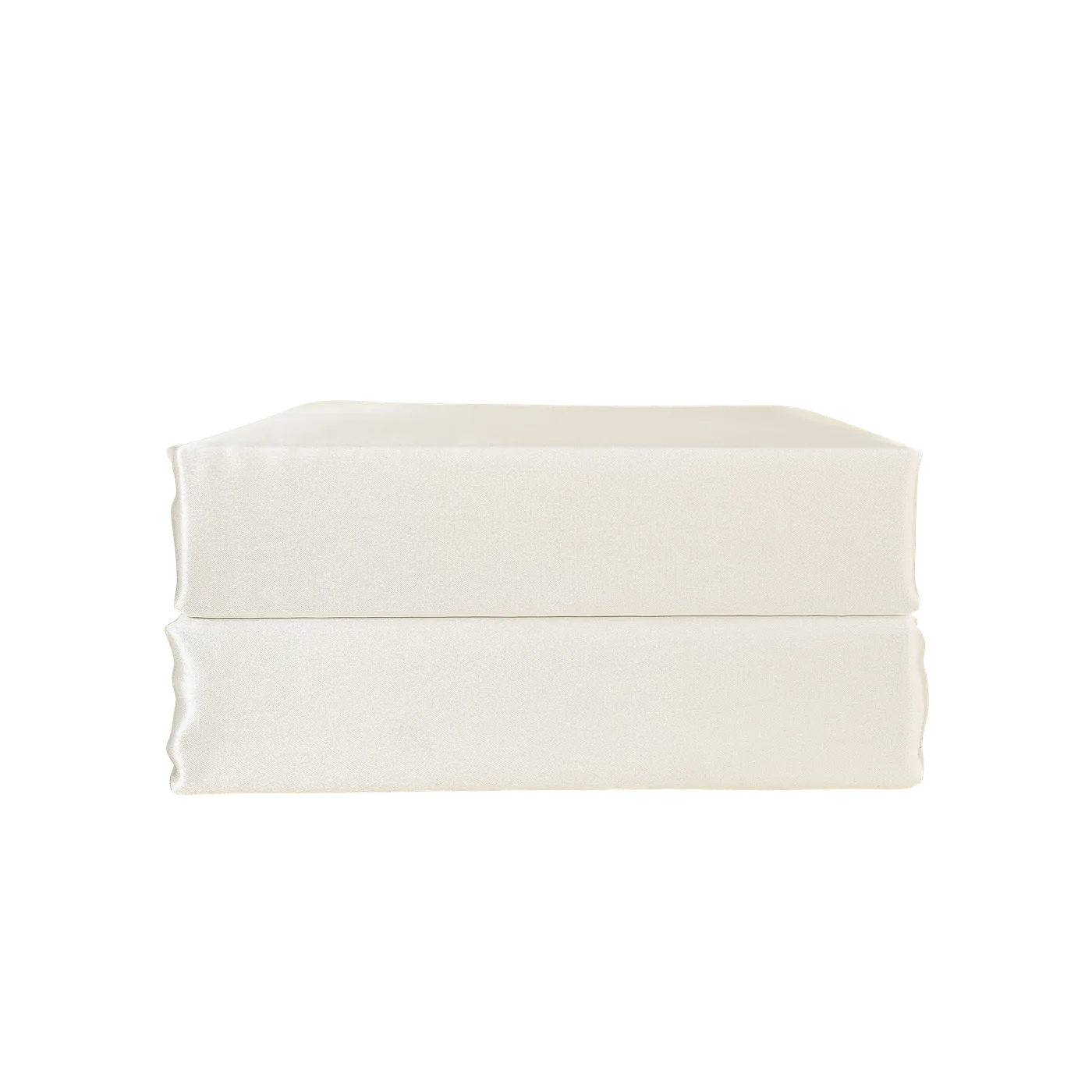
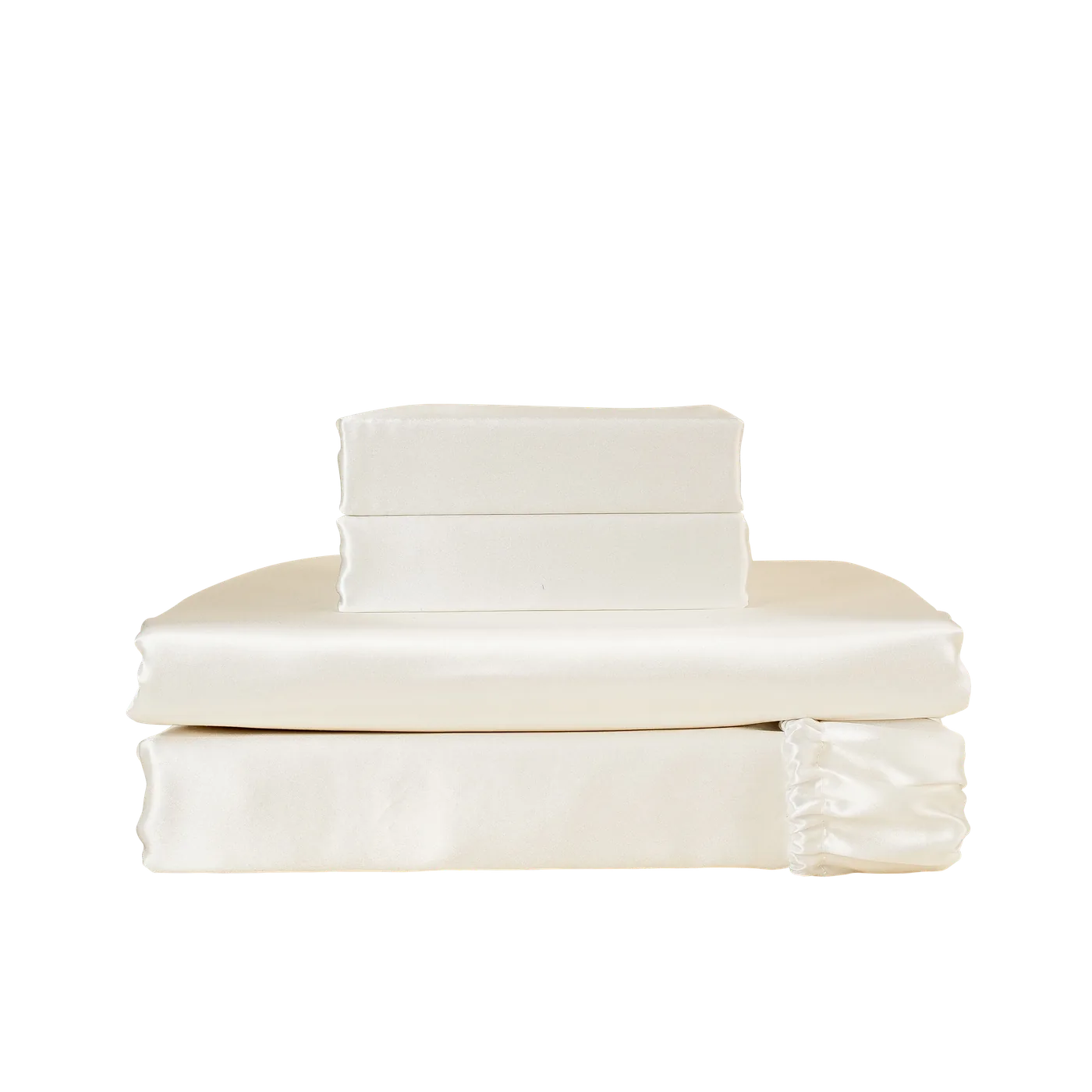
“Silk or satin?” is the wrong question — or at least an incomplete one. People ask it as if they’re two materials competing head to head, but they’re not the same kind of thing at all. Silk is a fiber. Satin is a weave. Once that clicks, almost every practical difference between the two pillowcases makes sense.
The core difference (fiber vs weave)
Silk is a natural protein fiber spun by silkworms. It’s the raw material itself — like cotton, wool, or linen. When you buy real silk, you’re buying that fiber, woven into fabric.
Satin is not a fiber at all. It’s a weave structure — a specific way of interlacing threads so that most of them float on the surface, creating that smooth, glossy face and a duller back. You can weave satin out of many fibers, including silk. But the catch is the part nobody advertises clearly: the inexpensive “satin pillowcase” you find in most stores is woven from polyester, a synthetic plastic fiber.
So the honest comparison isn’t “silk versus satin.” It’s “natural silk fiber versus a polyester fabric in a satin weave.” That distinction drives everything below.
| Silk pillowcase | Satin pillowcase | |
|---|---|---|
| What it is | A natural protein fiber | A weave (usually polyester fiber) |
| Source | Silkworms (Bombyx mori for mulberry silk) | Petroleum-based synthetic |
| Breathability | Breathes, regulates temperature | Traps heat, doesn’t breathe |
| Surface feel | Smooth, naturally cool then warms | Slick, stays cool/clammy |
| Hair & skin friction | Very low | Low |
| Static | Minimal | Can generate static |
| Durability | Excellent at high momme, ages well | Pills and snags over time |
| Care | Gentle: cold wash, air dry | Easy: machine wash, often dryer-safe |
| Cost | Higher | Lower |
What satin is usually made of (polyester)
This is worth dwelling on, because it’s the most common point of confusion in the entire category. When a product is labeled “satin pillowcase” with no fiber named — or worse, “silky satin” or “satin silk” — it is almost always 100% polyester.
Polyester is a plastic-derived synthetic. Woven in a satin pattern, it produces a shiny, slippery surface that mimics the look of silk on a shelf. But it behaves nothing like the natural fiber. Polyester doesn’t breathe, so it traps heat and moisture against your skin and hair. It can build up static. And while it survives rough laundering, it tends to pill and lose its sheen with time.
None of this makes satin “bad” — a polyester satin pillowcase is an affordable, low-maintenance upgrade over cotton. But you should know exactly what you’re buying. If breathability and natural-fiber comfort matter to you, “satin” on the label is a signal to check the fiber content, not a guarantee of silk. (For more on reading labels and spotting mislabeled silk, see our 6A grade and momme buyer’s guide.)
Hair benefits compared
The reason both silk and satin get recommended for hair is the same: they’re smooth, low-friction surfaces. Cotton pillowcases have a relatively rough, absorbent surface that tugs on hair as you move, contributing to friction, frizz, tangling, and the creases that turn into bedhead. A smoother surface lets hair glide instead of snag.
Both silk and satin reduce that friction, so either is a real improvement over cotton — this part is well supported. Where silk has the edge:
- Smoothness — high-grade mulberry silk has an exceptionally smooth, uniform fiber that glides past hair beautifully.
- No static — natural silk doesn’t generate the static that polyester satin sometimes does, which can leave flyaways.
- Breathability — silk doesn’t trap heat against your scalp, which matters for overall comfort overnight.
To be candid: for hair, the headline benefit is the friction reduction itself, and both materials deliver it. Silk just does it a little better and more comfortably. Claims beyond friction — that a pillowcase will dramatically change hair health on its own — go further than the evidence supports.
Skin & temperature compared
For skin, the same friction logic applies: a smoother pillowcase means less tugging and fewer overnight creases pressed into your face, which both silk and satin provide over cotton.
Temperature is where silk pulls clearly ahead. Silk is a breathable natural fiber that regulates temperature — it wicks warmth and a little moisture away, helping you stay comfortable through the night. Polyester satin does the opposite: it doesn’t breathe, so it traps heat and can feel clammy by the early hours. Satin feels cool when you first lie down because the slick surface conducts heat away initially, but that’s a first-touch sensation, not sustained regulation.
One honest caveat worth stating plainly: silk’s friction-reduction benefits for hair and skin are well-supported, but claims that silk is antimicrobial or that it clears up acne are not proven. Choose silk for comfort, breathability, and a gentle surface — not as a skincare treatment.
Durability, breathability & cost
Breathability isn’t close: silk breathes and regulates temperature; polyester satin traps heat. If overnight comfort is your priority, that alone may decide it.
Durability depends heavily on quality. A heavy, high-grade silk — 22-momme mulberry silk, for example — is genuinely durable and ages gracefully, developing a soft patina rather than falling apart, provided you wash it gently. Cheap polyester satin tolerates rough handling but tends to pill, snag, and dull over time. In other words, satin is harder to abuse, but good silk lasts longer and looks better as it goes.
Cost is the honest tradeoff in satin’s favor. Polyester satin is inexpensive to produce, so it’s cheap to buy. Real silk — especially top-grade, high-momme mulberry silk — costs more because the fiber and the weight are both premium. You’re paying for a natural fiber, breathability, and longevity.
Care differences (machine vs hand wash)
This is satin’s biggest practical advantage and silk’s main ask.
Satin (polyester) is forgiving. You can usually machine wash it on a normal cycle and often tumble dry it. For a busy household, that simplicity is genuinely appealing.
Silk needs a gentler routine — not difficult, just gentle:
- Wash in cold water, by hand or on a delicate machine cycle inside a mesh bag.
- Use a pH-neutral or silk-specific detergent — never bleach, and avoid harsh enzyme detergents.
- Skip the fabric softener and the high-speed spin.
- Air-dry flat or on a line, out of direct sunlight. Never put silk in a hot tumble dryer.
- Iron only on a low/silk setting if needed, ideally with a cloth between iron and fabric.
If you’d rather see this spelled out step by step, we have a full guide on how to wash silk sheets and pillowcases.
Which should you choose?
Choose polyester satin if your priorities are the lowest upfront cost and the ability to throw it in the wash and dryer without a second thought. It’s a smooth, friction-reducing upgrade over cotton at a budget-friendly price.
Choose silk if you want a natural fiber that breathes and regulates temperature, the gentlest surface for hair and skin, and bedding that lasts for years and feels genuinely luxurious — and you don’t mind a gentle wash routine. That’s the case for our silk pillow shams, woven from 6A grade, 22-momme mulberry silk and certified to OEKO-TEX Standard 100. If you want a different kind of breathable, easy-care comfort, our bamboo pillow shams are a softer, more machine-friendly natural-fiber alternative — and you can see all the options on our products page or compare them side by side.
The bottom line: don’t let “silk” and “satin” be presented as equals. One is a premium natural fiber; the other is usually a synthetic weave doing a decent impression of it.
Key takeaways
- Silk is a fiber; satin is a weave. Most “satin” pillowcases are polyester, not silk — this single distinction explains nearly every difference.
- Both reduce friction on hair and skin versus cotton, so either beats cotton; silk does it a bit better and without static.
- Silk breathes and regulates temperature; polyester satin traps heat and can feel clammy overnight, despite a cool first-touch feel.
- Good silk lasts longer and ages better, while cheap satin is more disposable but harder to damage in the wash.
- Satin is cheaper and easier to launder; silk costs more and needs gentle care (cold wash, no bleach, air-dry, no hot dryer).
- Silk’s hair and skin friction benefits are real; antimicrobial and acne claims are not proven — buy silk for comfort and breathability, not as skincare.